
The Universe, object of study since always, continues to be a mystery that attracts scientists’ attention through Astronomical Observations. To discover the secrets of stars, galaxies, and other celestial bodies, powerful instruments are employed: telescopes.
The observation of the Universe relies on analyzing the electromagnetic radiation of celestial bodies, but our Earth’s atmosphere presents a significant obstacle for astronomical observations. Light undergoes distortions and aberrations as it passes through atmospheric layers, reducing the clarity of images captured by telescopes, a phenomenon known as “seeing.”
Initially, astronomical observatories were located in high and arid places where the atmosphere is thinner and seeing is less pronounced. However, thanks to significant advancements in the production of optical components for telescopes, we can now observe the visible Universe with unmatched resolution and sensitivity from Earth.
In this article, we will describe the types of telescopes used for Astronomical Observations and their differences, the materials and components most commonly used, particularly mirrors, and the production techniques employed by precision optics manufacturers, who are committed to creating increasingly powerful instruments.

Telescopes for Astronomical Observations
Telescopes used for Astronomical Observations from Earth’s surface are Optical Telescopes, which are divided into two main categories:
- Refractors, or lens telescopes, which use a set of lenses to refract light and focus the image;
- Reflectors, or mirror telescopes, which use mirrors to reflect and collect light, focusing it onto a point called the focal point.
Refracting Telescopes consist of an eyepiece and an objective, a lens system that gathers light and focuses it to produce an image of the observed object. The lenses are held in place by rings that support them at the edges, for this reason lenses must be small to avoid deforming or breaking due to excessive weight. Consequently, Refracting Optical Telescopes are small in size, and large telescopes for Astronomical Observations are mainly Reflectors.
Reflecting Telescopes use a concave primary mirror as the objective and one or more smaller secondary mirrors of various shapes, depending on the telescope model. The larger size of the mirrors and, consequently, the telescopes that embed them, is ensured because mirrors can be supported from the back as well as the edges. Depending on the number and shape of the mirrors (parabolic, spherical, hyperboloid), different types of Reflecting Telescopes are designed for various purposes. These include, for example, the Newtonian reflector, the first and most classic telescope based on Isaac Newton’s design, Cassegrain, Cloude, Schmidt, or Ritchey-Chrétien telescopes.
By convention, Catadioptric Telescopes, mixed systems composed of lenses and mirrors such as the Maksutov and Schmidt-Cassegrain, are also included in this category.
To observe black holes, galaxy, and high-energy phenomena from non-visible Space, Optical Telescopes are insufficient. Astronomical Observations must be conducted directly from Space, requiring the use of X-ray telescopes for these studies. Mounted on balloons or satellites orbiting Earth, X-ray Telescopes use special concentric Reflective Mirrors, nested one inside another, and made from an ultra-thin layer of gold. The manufacturing of these mirrors is highly complex because, unlike optical telescopes that use the central part, these mirrors reflect through the sides, which must have extremely smooth metallic surfaces. These mirrors, being concentric and confocal, require a surface coating realized with the Multilayer Coating technique, where layers of high-density materials alternate with layers of low-density materials.
Production Materials for Optical Telescopes
The lenses of Refracting Telescopes, to reduce chromatic aberration, must be made from high-quality glass with a high refractive index and low dispersion. A high refractive index allows reducing the lens thickness, thereby decreasing the refraction effect, image distortion, and chromatic disturbances. Low dispersion helps correct chromatic aberrations.
The Mirrors of Reflecting Telescopes, having a single surface and not being subject to chromatic aberration, can be made from various types of glass with a virtually zero coefficient of thermal expansion, to withstand temperature variations during reflection.
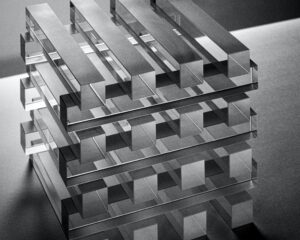 Some of the most commonly used materials for producing Optical Mirrors for Reflecting Telescopes include:
- Borosilicate glass (or Pyrex),
- Corning Ule (Ultra Low Expansion) glass, nearly zero expansion,
- Zerodur, or other ceramic glasses,
- Fused Silica (Quartz).
Tecnottica maintains a large stock of raw optical glasses and Fused Silica, provided by the leading global manufacturers. The raw glass is meticulously selected to ensure it is free from optical defects, such as bubbles, scratches, etc. The Company handles the cutting of blocks internally, for its production of Optical Mirrors.
Production Techniques for Optical Mirrors
The materials used to produce Optical Mirrors for Astronomical Observation must be worked with extreme precision, and are requiring a complex process, advanced skills, and cutting-edge technologies. At Tecnottica, the raw glass undergoes Grinding, Polishing (with optional aspherization/parabolization), and Coating processes. All stages are constantly monitored through advanced metrology systems to correct imperfections at every stage of processing, ending with a meticulous Quality Control.
The production process for lenses in Refracting Telescopes is similar with an optional addition of an anti-reflective surface treatment.
Grinding
Grinding is the phase where the mirror shape is formed achieving the desired curvature. This process involves multiple stages where the glass is treated with specific abrasives, such as diamonds, quartz, emery, silicon carbide (or carborundum), chromium, or iron oxide. These extremely hard, granular matter remove material from the glass surface during contact. The abrasives used become progressively finer during grinding to remove scratches left by the previous abrasive.
Throughout the various stages, the mirror’s curvature is carefully monitored and controlled using high-precision measuring instruments, ensuring that the final shape conforms to the required specifications.
Polishing
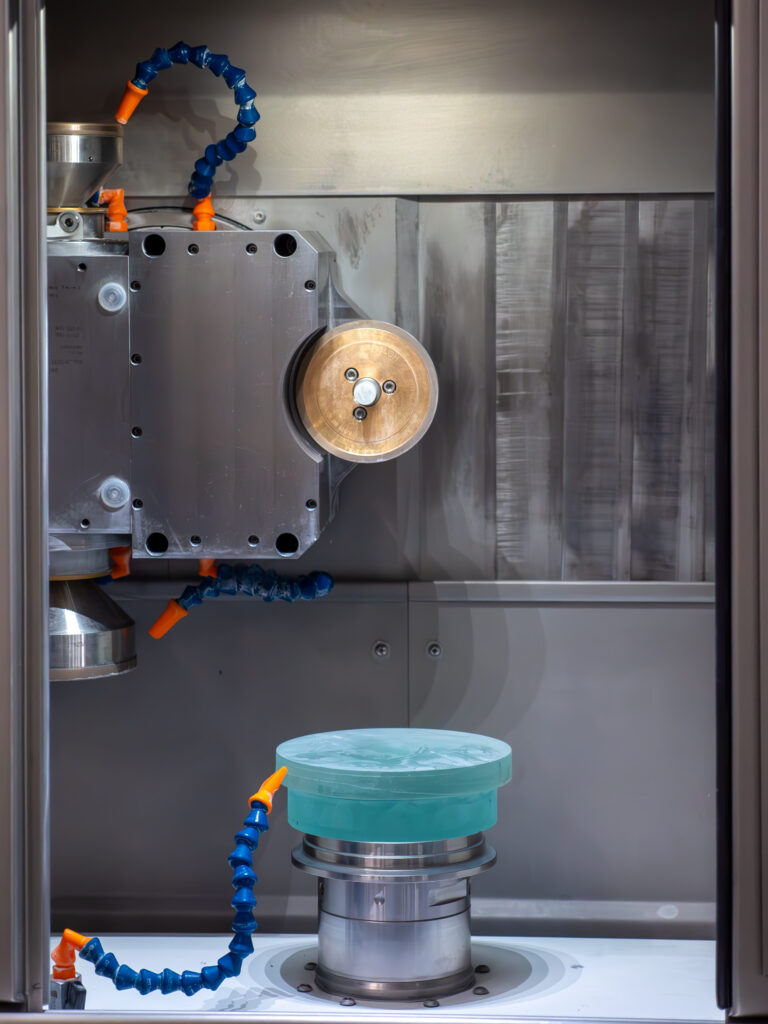
Polishing aims to make the surface perfectly smooth and reflective, eliminating any minor irregularities and preparing it for the Coating Treatment. During polishing, a special ultra-fine abrasive powder based on cerium oxide is used. The process proceeds with extreme precision and requires a significant expertise of the operator to achieve a perfectly uniform and a defect-free surface.
In situations where it is necessary to achieve very low form errors, or where it is necessary to parabolize or aspherize surfaces, standard polishing is completed by an additional polishing process with ‘zone’ corrections. In this case,
Here, using a high-resolution profilometer, feedback is constantly sent back to the machine, which applies corrections on the order of a few nanometers to small areas of a few millimeters in extent.
Coating
Coating or surface treatment with the correct reflective material is a crucial phase for achieving a reflective surface. The reflective metals commonly used for Astronomical Mirrors are Aluminum, Silver, and Gold, applied through processes of Aluminizing, Silvering, or Gilding.
Aluminum, due to its low cost, is the most widely used material for producing Mirrors for Astronomical Observations. Silver, because of its tendency to oxidize in harsh atmospheric conditions, is used only on large astronomical mirrors and it is exclusively applied through Atomic Layer Deposition. Gold is mainly used for infrared observation, because its reflectivity decreases towards the blue part of the spectrum.
Measurement, Quality Control, and Error Correction
Producing precision optical components requires meticulous control and correction of potential errors. Therefore, at the end of production, surface inspection with advanced Metrology Instruments is necessary to identify defects and aberrations and to define the process of correction.
Some errors can be avoided during the design phase of Mirrors by choosing the proper shape of the surfaces, with the help of advanced optical CAD software; one example is Coma, the most common aberration in Reflecting Telescopes with a parabolic mirror, which distorts images far from the optical axis.
The growing demand for larger mirrors in Optical Telescopes, essential for enhancing Astronomical Observations accuracy, necessitates increased diameters and, consequently, greater thickness. This trend has led Research to develop new production technologies, cutting-edge design tools, testing and usage of new production materials, and the creation of new optomechanical support structures.
Leveraging innovative technologies, state-of-the-art machinery, and highly skilled technicians with advanced expertise, Tecnottica produces Optical Mirrors for Astronomical Observations with exceptional purity, perfectly polished surfaces, and optimal reflectivity. The Company’s constant commitment to improvement enables the production of telescope components delivering exceptionally clear images, pushing the boundaries of our Universe understanding.
Tecnottica’s innovative spirit and dedication to customer satisfaction empower it to tackle even the most formidable challenges. By merging expertise, passion, and technology, we deliver Precision Optical Solutions that meet the intricate demands of Astronomical Research.