
The Confocal Microscope market, along with its essential lenses, is experiencing significant growth driven by increasing demand for high-resolution imaging in medical research, pharmaceuticals, and bioengineering. By 2024, the global confocal microscope market is evaluated $1.23 billion, with an annual growth rate of 4.38%, projected to hit $1.59 billion by 2030.
Among the sectors driving the demand of Confocal Microscopes there are ophthalmology and dermatology, where high-quality, non-invasive imaging is crucial for quick and precise diagnostics.

Laser Confocal Microscopy in Dermatology
Confocal Microscopes used in dermatology represent cutting-edge imaging tools capable of producing high-resolution, high-contrast images of biological samples. The technology operates by directing a laser beam through a series of lenses and a pinhole aperture to scan the sample point by point, and by eliminating out-of-focus light, delivering clear and sharp optical sections.
Unlike traditional microscopes that produce “flat” images, Confocal Microscopes create 3D reconstructions of samples by capturing images across different depth planes.
This ability makes Confocal Microscopy indispensable in dermatology for advanced, non-invasive diagnostics of skin conditions, including Melanomas, Keratoses, Psoriasis, Dermatitis and Autoimmune skin diseases.
By directly applying the probe to the skin’s surface, these devices allow in vivo tissue examination, eliminating the need for biopsies.
Technical Features of Confocal Microscope Lenses
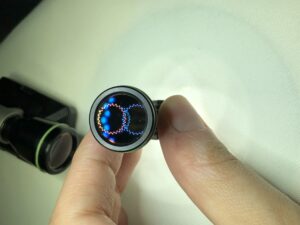
Confocal Microscopes rely heavily on the quality of their lenses to observe cellular structures with exceptional precision. To ensure reliable results and support accurate medical diagnoses, these lenses require precision engineering and manufacturing, with a margin of error within a micron.
To focus light on a precise point of the sample, deliver high resolution, and capture extremely fine details, Confocal Lenses must possess:
- High magnification and numerical aperture, essential for detailed imaging of complex tissues like skin.
- Low-dispersion optical glass substrates, to minimize aberrations and enhance light transmission.
- Multi-layer, Anti-reflective and UV Coatings to improve image quality by reducing light scattering and optimizing transparency, especially in applications with multiple wavelengths.
Technical challenges
The production of lenses for Confocal Microscopes presents significant technical challenges, particularly in meeting the high standards of quality and precision required for optimal imaging. Material selection, manufacturing precision, surface control, coating application, and meticulous measurement, handling, and assembly are all critical elements to achieving a flawless final product.
Tecnottica, with over 65 years of experience in the optics market and a commitment to continuous investment in cutting-edge machinery and specialized training, delivers unparalleled precision in the generation, polishing, and centering of Confocal Lenses.
Our dedicated Metrology Department ensures full quality control throughout the production process, from initial fabrication to final inspection. This guarantees that every optical component meets design specifications and is optimized for its intended application.
Our specialized Coating Department utilizes state-of-the-art methods, including EBE and IAD deposition techniques, to deliver superior directional coating, improved stratification, and high uniformity and purity.
Furthermore, Tecnottica’s extensive inventory of optical glass blocks ensures timely fulfillment of even the most specific or urgent client requests.

In dermatology, Confocal Microscopes have revolutionized diagnostic processes, particularly for conditions like skin cancer. These tools enable the identification of cellular anomalies in deeper skin layers without invasive procedures. Lenses play a vital role in maximizing the efficacy of confocal imaging for biomedical and dermatological applications.
As technology advances and integrates innovations, the field of confocal lenses is poised for continuous growth. Companies in this sector must stay ahead of emerging trends while maintaining exceptional quality standards to meet the demands of an evolving market.
Source: https://www.researchandmarkets.com/report/confocal-microscope