
Tecnottica lenses featured in a light sculpture by Shigeru Saito
Lenses have always been instruments to observe the world, but in some cases, they also become a medium to narrate it. This was the occurrence in the recent collaboration between Tecnottica Consonni and Shigeru Saito, a Japanese artist based in Italy, who chose optical lenses to shape Multiple Exposure: an immersive light sculpture that reflects, both metaphorically and physically, the expressive potential of light.
A Work of Art that speaks through light
Multiple Exposure is a sculpture made of stainless steel, glass, and aluminum that plays with the refraction, multiplication, and optical deformation of both natural and artificial light. The biconvex lenses, produced by Tecnottica according to the artist’s precise specifications, are an integral part of the installation, not mere components; active elements capable of shaping the viewer’s perception. The dimensions and curvatures of the lenses were defined based on the overall structure and balance of the work.
In this piece, Shigeru aimed to express the diversity of the world, not only in terms of biodiversity, but above all in values and individual perspectives.
“I have always been fascinated by the visual effects that glass creates when it interacts with light, and the changes in images generated by concave and convex surfaces. By using multiple lenses, the resulting images reveal a variety of appearances. That’s why I designed a complex structure, arranging lenses with two convex faces: to achieve a visual effect that is unpredictable and different depending on the direction of the light” – says the Artist.

The use of numerous biconvex lenses allows the creation of scenarios invisible to the naked eye. For instance, when one moves away from the sculpture, the projected object appears magnified; moving to the right, the image inside the lens shifts to the left. Every lens alters reality and reveals movements seemingly unrelated to the viewer’s motion.
“The world is made up of an infinite number of subjective opinions. There is no truly neutral object, unless seen through the eyes of a higher being. As in Heisenberg’s uncertainty principle, no matter how hard we try to be objective, our perceptions cannot bear fruit unless they pass through our mind and body”- declares Shigeru Saito.
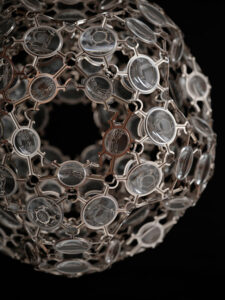
Dimensions: 690 x 690 x 690 mm – 24 kg
View the Artwork page on Shigeru Saito’s website https://www.shigerusaito.net/portfolio-item/multiple-exposure/
Watch the video on YouTube https://youtu.be/TorXiikxFYQ
In real life, we must coexist with countless subjective viewpoints. Even once objective rules are established, they will always be interpreted through personal perspectives.
An unexpected collaboration
As often happens in the most authentic projects, the collaboration came about spontaneously. The Artist found Tecnottica online. He was looking for an Italian company with strong technical capabilities, extensive experience, and the ability to produce custom glass lenses with very specific characteristics in small quantities.
He reached out to the company, and it was only once the work was completed that the artistic context into which those components would be placed was revealed. Applying precision Optics in an environment that transcends technical limits to become a vehicle for creative inspiration demonstrates the versatility and professionalism of the company.
The lens as a visual language
For Tecnottica, Multiple Exposure was an opportunity to observe its lenses from a different perspective, not only as tools for generating accurate images, but also as instruments for creating visions.
“It’s not every day that our lenses become the stars of an artwork. But with Multiple Exposure, that’s exactly what happened,” says Angelo Fasoli, CSO of Tecnottica. “Through this piece, the lenses reveal their dual nature: functional and poetic, technical and narrative. We’re proud to have contributed, through our manufacturing expertise, to the creation of a work of art that tells something new about us, about light, and about how we perceive it.”
In a time when cross-disciplinary collaboration is increasingly valued, this project proves that technology can generate beauty, and that even a highly technical component like a lens can become a symbol.
We thank Shigeru Saito for choosing our lenses as part of his artistic language.
About the Artist
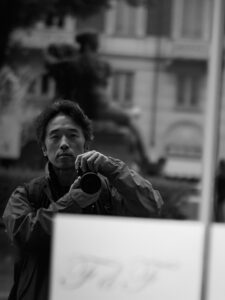 Shigeru Saito was born in Tokyo in 1974. He lives and works in Turin (Italy).
In 1997 he graduated in Fine Arts at Meisei University. His education was also completed with studies of Industrial Design and Architecture. In 2000 and 2002 he exhibited at the International Sculpture Exhibition of Kajima, in Tokyo, receiving awards and recognitions in both editions.
In Japan, he met Kunio Kondo, sculptor and professor of traditional Japanese architecture, great friend of Enrico Castellani, who introduces him to the works of the Italian artist. Saito was stunned by Castellani’s relief surfaces. This originated a deep and profitable bond with Italy and fruitful research on materials that Saito studies with constant passion and dedication. Wood, marble, metals: the ability to bend these materials to the artist’s will is distinctive in his work. He creates works that oscillate between the minimalism of composition and geometrical virtuosity, everything concretized in harmonious forms, very often starting from the analysis of platonic solids.
From 2005 to 2007 he is delegated to Italy for artistic research on behalf of the Ministry of Cultural Affairs of Japan.
In 2006 he exhibited at the 13th International Biennale of the Museum of Sculpture of Carrara. In 2013 he participates in the exhibition Infinite Reflection at the CaMusAC in Cassino, where his works are placed into dialogue with those by Castellani.
Over the past 15 years, numerous sculptural commissions were assigned to Saito between Japan and Italy. The last one was a public commission for the realization of a work for the Florence Courthouse, following his winning of a contest organized by the city.
Learn more about his work: www.shigerusaito.net
Any use of images or content related to the artwork must be approved by the artist, in accordance with his requests.