
In November Tecnottica takes part in two events dedicated to astronomy and space, in Lyon and in Bremen. They are an opportunity to explain what it means to manufacture optical components for space applications.
On 2 and 3 November we will be in Lyon for the Industry Days of WST (Wide-field Spectroscopic Telescope), the 12-metre wide-field spectroscopic telescope that a consortium of European and Australian research institutes is designing as the next major facility of the European Southern Observatory (ESO), after the Extremely Large Telescope. The proposal will be submitted to ESO in December 2027, and the Industry Days are meant to present the project to companies in the field and to gather their point of view.
From 17 to 19 November we will be in Bremen for Space Tech Expo Europe, Europe’s leading B2B exhibition and conference for the space industry, which this year takes place in the German city for the last time.
A ground-based telescope and a satellite in orbit have different needs, but they confront optics manufacturers with the same dilemma: how do you demonstrate that a component will perform for years, in conditions that cannot be controlled and, if in orbit, with no possibility of correcting it after installation?
Tecnottica’s answer: precision
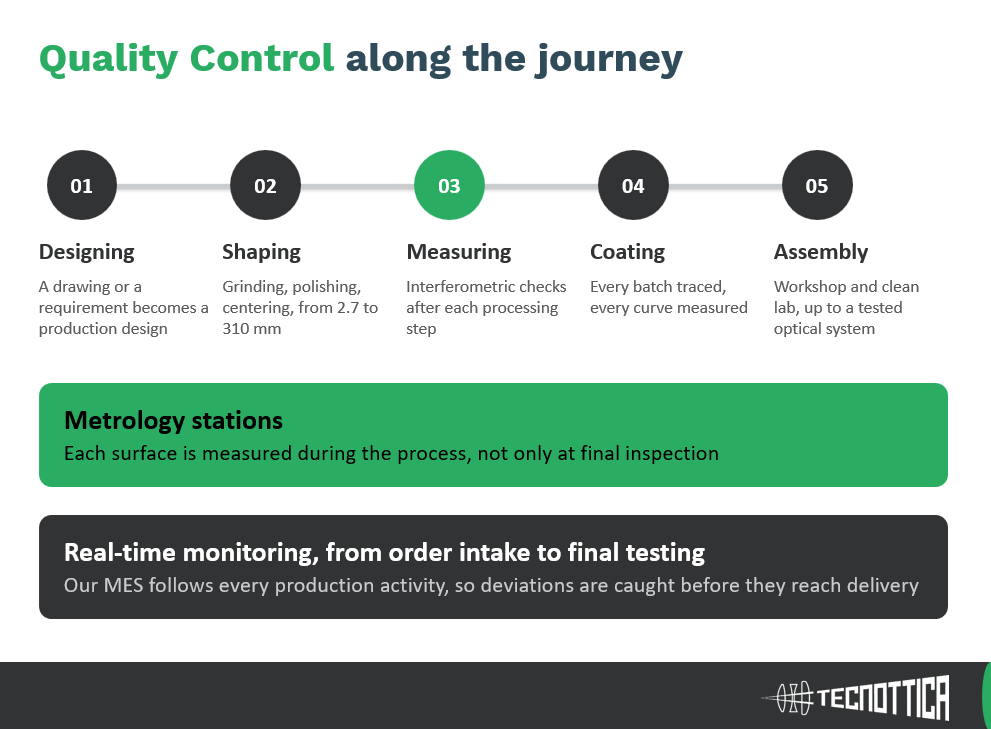
At Tecnottica every lens follows a five-stage journey: the brief, which our technical office turns into a production drawing; processing in Calco, with grinding, polishing and centring on diameters from 2.7 to 310 mm; coating in our Scandicci department; assembly and final testing.
Along this journey, two levels of control run in parallel.
- The first is metrology: the lens returns to the interferometer after the critical steps defined in its process cycle, not only at final inspection. We measure radii of curvature with sub-micrometric accuracy, surface form according to ISO 10110, centring below 5 arc seconds and roughness down to 0.15 nm, while on assembled systems we verify focal length and MTF. Every component can be supplied with its own measurement report.
- The second is production monitoring. Our MES tracks every activity in real time, from order intake to final testing. In space and scientific programmes any delay can halt the entire integration phase; knowing the production status of a component, and whether its processing is progressing as planned, is no longer only organisational information but technical information too.
Coatings for extreme environments
An optical surface made to tight tolerances, but with a coating that cannot withstand the environment it will work in, is a lens that cannot do its job. This is why every coating is verified against the conditions it will be exposed to. In-house we carry out adhesion tests, moderate and severe abrasion tests, cleaning solvent compatibility tests and spectrophotometric measurements on samples made from the same glass as the component.
For space applications, qualification tests for extreme environments are added: thermal vacuum and thermal cycling, damp heat at 90% relative humidity, and exposure to atomic oxygen, particles and UV radiation. These tests are performed according to the requirements of each programme. The reference standards are ISO 9211, ISO 9022 and ECSS-Q-ST-70-17C on coating durability. In 2025 we expanded the qualifications of our coatings for aerospace and high-power laser applications.
Replicability
Many space and astronomy projects start from a few prototypes and grow into series of components that must all behave in the same way. Replicability is a fundamental requirement, so the process developed for the first piece has to be repeated, monitored and measured for every piece that follows. In-house metrology and coating, together with continuous production monitoring, reduce variability between pieces and batches and ensure greater reliability in the transition from prototype to series.
Building manufacturing capacity for the aerospace market has taken years and continuous investment. It is with this in mind that we are expanding our Calco plant with 700 m² dedicated to production, metrology and quality control, operational by summer 2027.
We are going to Lyon and Bremen first of all to listen, and to learn about the technology roadmaps of new instruments, the requirements of missions and the needs of those who integrate optical systems in critical environments. It is a conversation that involves the customers and partners we work with, the glass and material suppliers who share responsibility for quality with us, and the organisers who create these meeting points between research and industry.
In Lyon we will give a presentation on the manufacturing process of a precision lens, “The journey of a lens: making and measuring precision optics”, delivered by our Technical Manager, Francesca Brambilla; in Bremen you will find us at the Messe Bremen exhibition centre, in the Italian Pavilion organised by ICE, Hall 5, Stand P10.
If you will be in Lyon or Bremen, we will be glad to talk in person!